Lead Product Manager · 2024–2025 · AI-POWERED WEB GAME ENGINE
Erth.ai
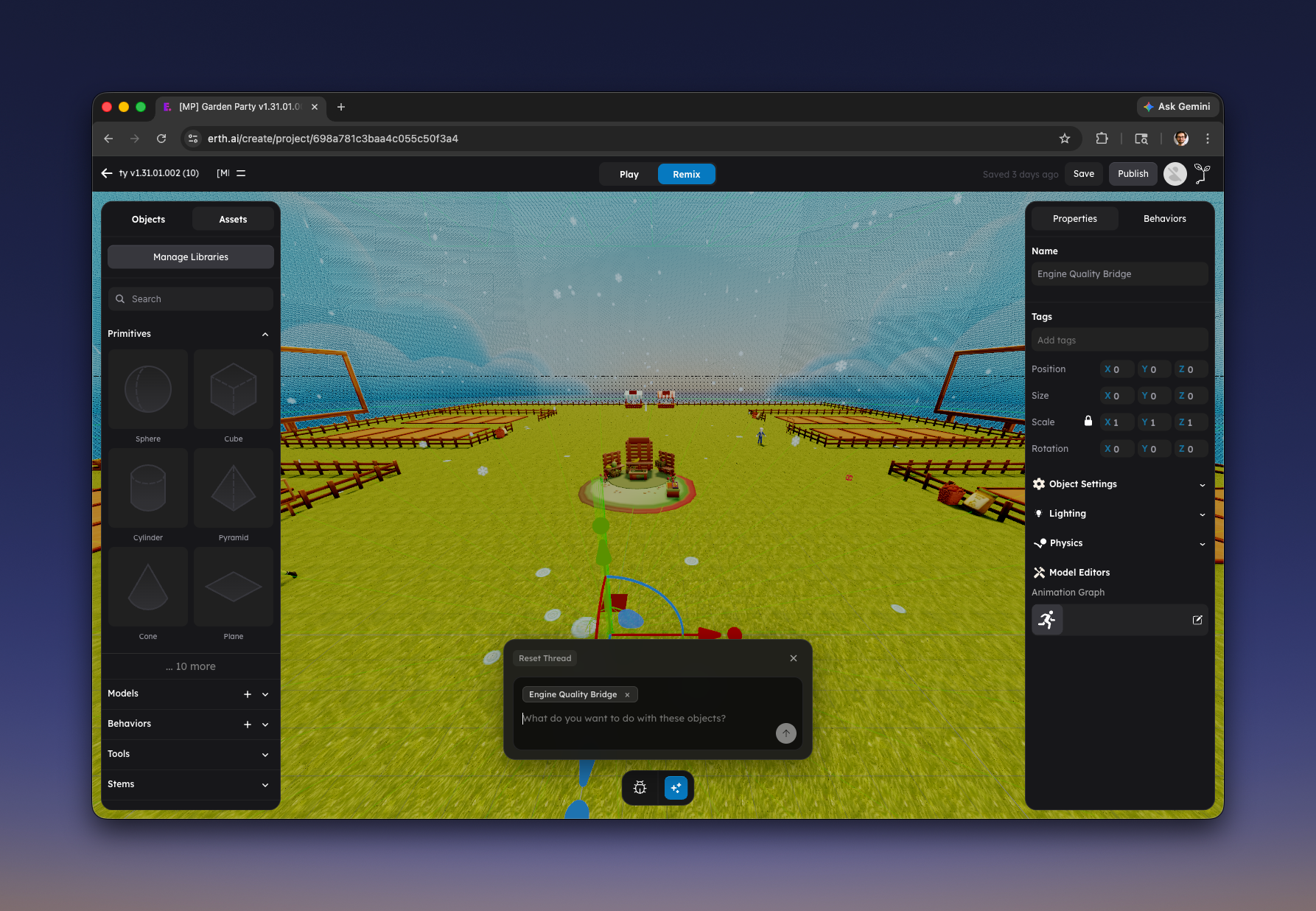
Erth.ai is a browser-based, AI-enabled game engine—anyone can generate 3D models, assets, and interactive experiences through a prompt interface. I joined as PM with end-to-end accountability for the editor, running user research with alpha testers and shaping design with the CEO and CTO. Signal was entirely qualitative; we had no dashboard to hide behind.
The problem space
Two hard problems in tension: how do you make a 3D creative tool accessible to a 13-year-old without limiting an indie developer? And how do you design for AI outputs that are inherently unpredictable—where the user's mental model must survive things going sideways?
Users
Three distinct personas shaped every decision: indie developers who wanted AI as a power tool with full code access; web developers who wanted to experiment freely; and non-technical creators—often teenagers—who stopped the moment something didn't behave as expected. That last group was the most revealing.
Making AI legible
01Our early instinct was to hide what the AI was doing. It was wrong. I noticed it first in myself: prompt, get output, feel stuck—no idea why it looked that way or where to go next. Younger users had no recovery path at all.
We responded with three layers of transparency: a visual feedback layer that showed what changed after every prompt in plain language; progressive disclosure giving developers an opt-in view of generated code and AI decision logic; and a suggestion engine that offered follow-up prompts after every AI action so users always had somewhere to go next.
Alpha testers engaged significantly longer after it shipped. An unexpected finding: many users weren't trying to make a game—the act of prompting and watching the AI respond was the experience. That raised a harder question we didn't fully resolve: were we building a game engine or a creative sandbox?
Reflection
02The accessibility-vs-power tension was never fully resolved—there's a version of this that requires rethinking more fundamental editor primitives. I'd also invest earlier in longitudinal research; watching the same users return across sessions would have surfaced confusion we discovered too late.